Tiny Trainings Books for Psychotherapists.
About the Series
Tiny Trainings is a series of focused, practice-based books for mental health professionals who want to think more clearly, work more skillfully, and meet their continuing education requirements without sitting through another webinar that could have been an email.
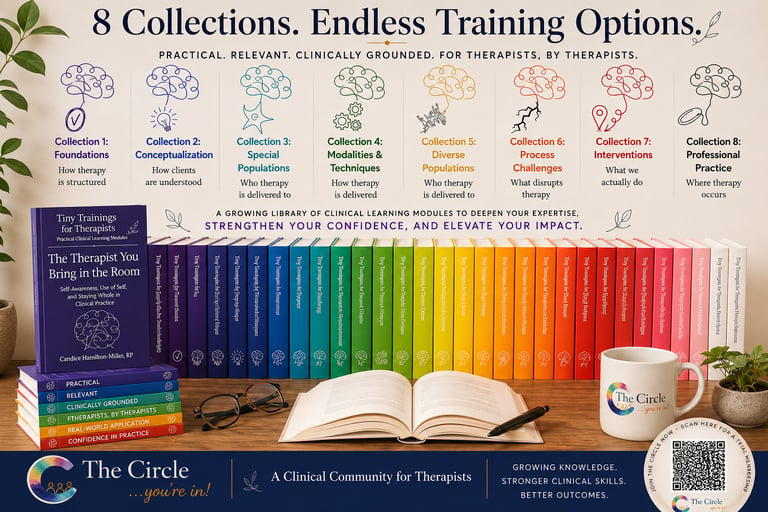
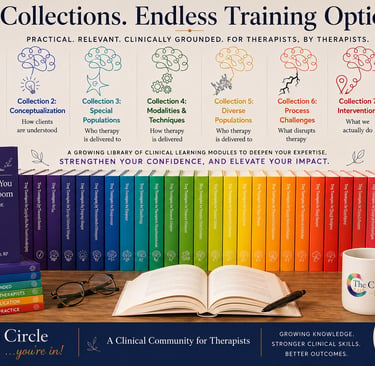
Each volume targets a specific aspect of clinical practice — the structural foundations that hold therapy together, the conceptualization skills that sharpen how clients are understood, the neurodivergence-informed adaptations that make care genuinely responsive, the intervention frameworks that translate theory into in-session action. The series spans eight thematic collections covering the full scope of psychotherapeutic practice: from consent conversations and documentation through to burnout, shame, precision treatment frameworks, and the business of running an ethical private practice. Whatever is getting in the way of doing the work well, there is a title for it.
What makes Tiny Trainings different is the approach. These are not textbooks, and they are not watered-down summaries of ideas you half-remember from graduate school. Every volume is supervision-informed — written the way a skilled supervisor actually talks about clinical work, with the ambiguity left in, the grey zones named, and the case examples close enough to real practice to be genuinely useful. The focus throughout is clinical reasoning: not what to do, but how to think about what to do, and why the distinction matters.
Each book is designed to provide 2–3 hours of Self-Directed Continuing Education, which means the series functions as a complete CE library that clinicians can work through on their own schedule, at their own pace, in whatever sequence matches their current caseload or professional development priorities. No registration deadlines. No live attendance requirements. No courses designed around the lowest common denominator of a mixed audience. Just focused, applied reading that meets practitioners where they actually are — and counts toward the hours they actually need.
The result is a series that treats continuing education the way good supervision treats professional development: as something that sharpens practice, not something to get through.
The Tiny Trainings Collections
The Foundations Collection is about everything that holds therapy together before a single intervention is ever delivered — and everything that falls apart when it isn't done well. Consent, documentation, session planning, goal setting, risk, crisis, endings: these topics got maybe a lecture and a half in graduate school, and they account for the majority of regulatory complaints, licensing board headaches, and therapeutic ruptures that practitioners face in actual practice. Each title uses supervision-informed discussion, case-style examples, and direct implementation guidance to develop the skills that hold a practice together — treating foundational practice not as compliance to be managed, but as clinical skill to be developed. Because how a therapist handles a consent conversation tells a client something about safety before the work even begins.
The Conceptualization Collection treats case conceptualization as a thinking discipline, not a template to fill out. Understanding clients — building working hypotheses, tracking patterns, holding multiple explanatory frameworks without reducing the person in front of you to a checklist — is a clinical skill that most training programmes gesture at without actually developing. This collection develops it, from diagnostic and assessment literacy through behavioural and functional conceptualization, theory of mind as a precision clinical instrument, and the layer of working hypotheses and cognitive habits that run beneath explicit technique.
The Neurodivergence Collection is built on a single premise: standard therapeutic approaches were not designed with neurodivergent nervous systems in mind, and adapting clinical delivery is not an accommodation — it's a clinical competency. Across ADHD, autism, anxiety, executive functioning, and the overlapping terrain between them, these titles move clinicians from diagnostic literacy to genuine in-session adaptation, examining what engagement, progress, and therapeutic alliance actually look like when the therapist stops assuming the standard model fits.
The Modalities & Techniques Collection addresses the question that lies beneath most clinical training but rarely gets asked directly: not which approach to use, but how to think about choosing, combining, and delivering therapeutic approaches in response to the specific person in front of you. Graduate training presents modalities as competing paradigms. Working clinicians discover the reality is integrative — and that integrating thoughtfully rather than eclectically by default is a skill most programmes leave entirely unanswered.
The Populations Collection addresses a consistent gap in generic clinical training: the ways that therapeutic approach must genuinely adapt — not merely modify terminology — when working with specific client groups. Children and families, 2SLGBTQIA+ clients, eating disorders, cultural humility, neurodivergence, pharmacological literacy, depression, PTSD — each title is grounded in the clinical reality that population context shapes presenting concerns, alliance dynamics, safety considerations, and what responsive care actually looks like in the room.
The Interventions Collection is about what therapists actually do in session — the specific clinical moves, frameworks, and tools that produce change. Where the Modalities & Techniques Collection develops the meta-skill of choosing and combining approaches, this collection gets into the room: anxiety treatment, interoception, regulation science, working with the body, creativity as in-session responsiveness, and precision treatment frameworks for depression, PTSD, and ADHD. Knowing a technique is not the same as knowing how to deploy it, and every title is built to develop clinical judgment alongside clinical skill.
The Process Challenges Collection examines what happens when therapy gets hard — not because the therapist is doing something wrong, but because the clinical terrain demands it. Ambivalence, shame, readiness, therapist insecurity, burnout: these don't appear on intake forms. They emerge mid-session, catch practitioners off-guard, and require a kind of clinical self-awareness that is entirely distinct from intervention knowledge. These titles treat the difficult interior landscape of therapeutic work as developmentally significant territory, not as failure to be corrected.
The Professional Practice Collection addresses the full context in which psychotherapy occurs — the business decisions, regulatory obligations, supervision relationships, and career questions that shape what it's possible to offer clinically. Ethics in private and group practice, CRPO obligations, boundaries, dual relationships, specialisation, supervision, AI, single session therapy: the topics most training programmes leave clinicians to figure out through trial and error, and that quietly determine whether a practice is viable, ethical, and sustainable.
CHM Therapy Services
Connect
Candice Hamilton-Miller, RP.
candice@chmtherapy.com
FAX:
(647) 977-6318
OFFICE:
(647) 969-HELP (4357)
(647) 886 3380
Visit
142 Martin St, Milton, ON
245 Commercial St, Milton, ON
Hours
Available by appointment only.

If you have any questions or want to schedule an appointment with one of our team members
Email or Call us
(647) 969 HELP (4357)
candice@chmtherapy.com
Copyright: 2010-2024 CHM Therapy Services | Serving Milton, Oakville and Ontario Virtually | SEO By Infused Agency
Looking for education, tools, or reflective learning rather than psychotherapy?
Mindful Humans Studio is a non-clinical learning space founded by Candice Hamilton-Miller, RP, offering education and resources focused on self-awareness, emotional understanding, and intentional living.